

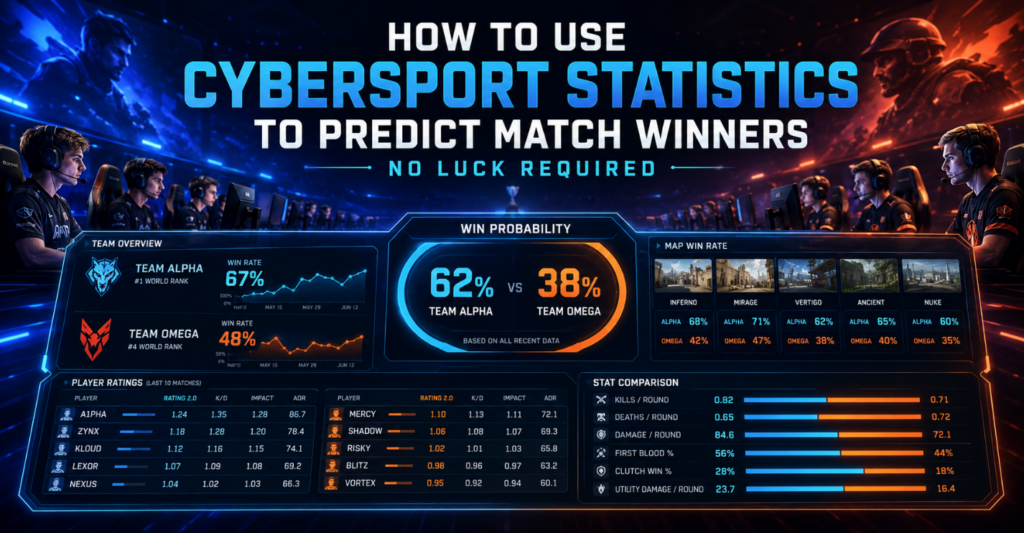
Predicting esports match winners should not be based on random guesses, fan hype, or simple luck. A smarter approach starts with statistics, match context, team form, player impact, and fresh news. When you study real Cyber sport data, you can better understand which team has stronger chances before the game begins.
Why Cyber Sport Statistics Matter
Cyber sport statistics matter because they turn predictions into a more structured and logical process. Instead of choosing a team because it is popular or because you personally like the roster, you can review actual performance indicators. Stats show how teams compete, where they are consistent, which maps suit them best, and what weaknesses may affect the final result.
A useful starting point is following reliable cybersport sources that publish match previews, team updates, news, and game news. This allows you to combine numbers with current context, which is important because statistics alone do not always explain the full match picture.
Statistics Reflect Real Team Performance
Team reputation can often create a false impression. A famous organization may have loyal fans, strong branding, and past trophies, but that does not always mean the current lineup is playing well. Statistics help you evaluate what is happening right now.
Useful team statistics include:
For example, a team may look dominant after several wins in a row. However, if those wins came against weaker opponents, the streak may not be as impressive as it seems. Another team may have fewer wins overall but stronger results against top-level opponents. That difference is important when predicting match winners.
Stats Help Avoid Emotional Predictions
Many fans predict matches based on personal preference. They support their favorite team, trust a popular player, or follow the biggest name in the matchup. This approach is common, but it often leads to weak predictions.
Statistics make the process more objective. Instead of asking which team you like more, you can ask:
This does not mean emotions should be ignored completely. Esports is still unpredictable, and that is part of its appeal. However, using numbers makes your prediction based on facts rather than fan loyalty.
Numbers Reveal Hidden Strengths and Weaknesses
Some teams look average at first glance but have strong hidden advantages. Others may seem powerful because of their name, but deeper statistics can reveal clear problems.
For example, a team may have:
At the same time, another team may struggle with:
- Losing anti-eco rounds
- Weak CT-side defense
- Poor results on decider maps
- Low opening kill conversion
- Bad performance against aggressive teams
- Overdependence on one star player
These details are easy to miss if you only check the final score. But when two teams are close in skill, small statistical differences can have a major impact.
Statistics Make Match Context Clearer
A match result is not only about who won or lost. The context behind the score matters. A 2-0 win can look dominant, but both maps may have been extremely close. A 2-1 loss can still show a strong performance if the losing team pushed a top opponent into overtime.
That is why you should look beyond simple results. Important context includes:
For example, if a team loses 14:16 against a top-ranked opponent, that may be a positive sign. If another team wins 13:11 against a much weaker opponent, that may actually be a warning sign.
Fresh News Makes Statistics More Accurate
Statistics are powerful, but they can become outdated quickly. A team can replace a player, change roles, bring in a new coach, or enter an event with a stand-in. In these situations, old data may not fully reflect the current state of the roster.
This is why news and game news are important for prediction. Fresh updates can explain changes that raw numbers do not show.
Before using statistics, check:
For example, a team may have excellent results from the last three months. But if its main in-game leader is missing, those statistics become less reliable. On the other hand, a new player may bring fresh energy and improve the team faster than expected.
Stats Do Not Guarantee Wins, But They Improve Decisions
No statistic can guarantee the winner of an esports match. Unexpected mistakes, technical issues, pressure, or individual brilliance can still change the outcome. That unpredictability is one reason Cyber sport remains exciting.
However, statistics help reduce random guessing. They allow you to compare teams using real indicators instead of simple assumptions.
A strong prediction usually combines:
When these factors point in the same direction, your prediction becomes much stronger. It is still not guaranteed, but it is no longer based on luck.
Check Recent Team Form First
Recent form shows how well a team is performing right now. In many cases, it is more useful than results from several months ago.
A team that won seven of its last ten matches may look strong. However, you still need to check who they played against. Beating weaker teams does not always mean the lineup is ready to defeat a top-tier opponent.
Focus on the Last 5-10 Matches
Recent matches show the current level of a team. A strong ranking means less if the team has started losing often or struggling against better opposition.
Look at:
Check the Quality of Opponents
A winning streak is more impressive when it comes against strong teams. If a team only beats weaker opponents, the numbers can be misleading.
Always compare recent form with the level of competition. This makes Cyber sport analysis more accurate and prevents you from overrating simple win streaks.
Analyze Map Performance
Map statistics are one of the most important parts of match prediction, especially in CS2 and other tactical esports titles.
Some teams are very strong on specific maps but weak on others. A team may have a 75% win rate on Mirage but only 35% on Ancient. If the match format allows bans and picks, map pool depth becomes a major factor.
Review Best and Worst Maps
Before predicting a match winner, check which maps each team prefers. A team with one strong map can be dangerous in a best-of-one. But in best-of-three matches, deeper map pools usually matter more.
Check:
Understand Map Veto Logic
Map veto can completely change a match. One team may be stronger overall but weaker on the final map pool.
If the likely maps favor the underdog, the match may be closer than the odds suggest. This is why map data should always be combined with news, game news, and roster context.
Study Head-to-Head Results
Head-to-head statistics show how two teams performed against each other in previous matches. This can help reveal style-based advantages.
Some teams simply match up well against specific opponents. They understand their strategies, punish their weaknesses, or control the pace better. However, head-to-head results should not be used blindly.
Do Not Overvalue Old Matches
Old matches can be misleading. Teams change players, coaches, tactics, and roles. A result from last year may not reflect the current level.
Always check:
Look for Style Advantages
Some teams struggle against aggressive opponents. Others perform badly against slow, tactical teams.
Head-to-head data is useful when it shows repeated patterns, not random one-time results. If the same weakness appears several times, it may be a real factor in the next match.
Look at Player Statistics
Team results are important, but individual player statistics can explain why a team wins or loses.
In many esports games, one star player can change the outcome of a match. In CS2, for example, a strong AWPer or entry fragger can create early advantages. In Dota 2 or League of Legends, a carry player with strong farming and teamfight stats can decide late-game situations.
Identify Key Players
Every team has players who create impact. Some open rounds. Some win clutches. Others support teammates, control space, or make important calls.
Useful player stats include:
Check Team Balance
Do not focus only on one superstar. A team with balanced performance from all players is often more stable than a team that depends on one person.
If one player must carry every match, the team becomes easier to predict and counter. Balanced teams usually handle pressure better, especially in playoff matches.
Follow Roster Changes and Injuries
Statistics become less accurate when a team changes its lineup. A new player can improve the team, but they can also create communication problems at first.
This is where news and game news become important. Before making a prediction, check whether the team has a stand-in, a new coach, internal issues, travel problems, or recent role changes.
Watch for Stand-Ins and Role Changes
A stand-in can weaken team structure, even if the player is skilled. Roles also matter. If a rifler changes position or a captain changes calling style, performance can become unstable.
Important factors include:
Combine Stats With Current Updates
Raw data may not show hidden issues. Fresh Cyber sport updates can explain why a team suddenly performs better or worse.
That is why current news should always be part of the prediction process. When statistics and fresh updates support the same conclusion, the analysis becomes stronger.
Compare Tournament Motivation
Not every match has the same value for both teams. Some teams fight for playoffs, while others may already be eliminated or qualified.
Motivation can affect performance. A team playing for survival may take more risks and prepare harder. A team that already secured its spot may hide strategies or play less aggressively.
Understand What Is at Stake
Before predicting the winner, ask:
Match Context Can Change Everything
A team may look stronger statistically but play carefully if a bigger playoff match is ahead. Another team may overperform because it has nothing to lose.
Context makes statistics more useful and realistic. It also helps explain why a match can differ from what rankings or odds suggest.
Watch Economy and Round Conversion Stats
In games like CS2, economy control is a key part of winning matches. Some teams are excellent at converting advantages, while others often lose rounds after getting early kills.
These details can reveal whether a team is disciplined or unstable under pressure.
Review Round-Based Numbers
Important round-based stats include:
Look for Consistency Under Pressure
A team that wins pistol rounds and converts anti-eco rounds can build early momentum. A team that often loses advantage rounds may struggle even with strong aim.
These stats help identify hidden weaknesses before the match starts. They are especially useful when combined with current game news and recent match analysis.
Do Not Trust Odds Alone
Betting odds can be useful, but they should never be your only source of analysis. Odds show how the market sees a match, but they do not always show the full reality. A team can have lower odds because it is popular, not because it has a clear statistical advantage.
To make smarter predictions, compare odds with real Cyber sport data, current news, game news, roster updates, and match context. This helps you understand whether the favorite is truly stronger or simply overrated by the public.
Odds Reflect Market Opinion
Odds are based on probability, bookmaker margins, and betting activity. They can give you a general idea of which team is expected to win, but they are not a guarantee.
A favorite may have short odds because:
- The team has a famous name
- Many fans are betting on them
- The team has a strong ranking
- Past results make them look safer
- Public hype affects market movement
This is why odds should be treated as one signal, not the final answer.
Popular Teams Can Be Overrated
Big teams often attract more attention. Their matches get more coverage, more discussion, and more bets from casual fans. Because of this, their odds may become less valuable.
For example, a famous team may look like a safe pick, but deeper statistics can show problems such as:
In this case, the odds may not fully reflect the risk.
Underdogs Can Offer Better Value
An underdog does not need to be the clear favorite to be interesting. Sometimes a team with higher odds has a better chance than the market suggests.
This can happen when the underdog has:
If the statistics support the underdog, the match may be closer than the odds show.
Compare Odds With Real Data
The best approach is to compare market expectations with actual performance indicators. If the odds and the statistics tell the same story, the prediction becomes stronger. If they disagree, you need to investigate further.
Before trusting the odds, check:
This process helps you avoid blind betting and emotional predictions.
Look for Value, Not Just Winners
Good prediction is not only about finding the team that is most likely to win. It is also about understanding whether the odds make sense.
A strong favorite may win the match, but the odds can be too low to offer real value. At the same time, a slight underdog may lose, but still be a better analytical pick if the match is much closer than expected.
Ask yourself:
- Are the odds fair based on current stats?
- Is the favorite really that much stronger?
- Does the underdog have a clear path to winning?
- Are fans pushing the odds in one direction?
- Did recent news change the situation?
This makes your prediction more balanced and less dependent on hype.
Odds Should Support Analysis, Not Replace It
Odds are useful when they confirm what your research already shows. They become risky when you use them instead of doing analysis.
A smart prediction should combine:
- Statistics
- Team form
- Map data
- Player performance
- News
- Game news
- Match context
- Market odds
When all these factors point in the same direction, your prediction becomes more logical. It still may not be perfect, but it is based on analysis rather than luck.
Build a Simple Prediction Checklist
A structured checklist helps you avoid emotional decisions. Instead of choosing a team because you like them, use a clear process.
This checklist will not guarantee a correct result, but it will make your decision more logical and easier to repeat.
Main Factors to Check
Before predicting a winner, check:
Score Each Team
You can give each team a simple score from 1 to 5 in every category. The team with the stronger total score usually has a better statistical case.
This method keeps the prediction process clear and less emotional. It also helps you compare Cyber sport matches using the same logic every time.
Common Mistakes to Avoid
Many people make predictions based on hype, favorite teams, or one recent match. This often leads to poor decisions.
To use statistics correctly, you need to avoid shortcuts. One number is never enough to explain a full match.
Mistakes That Hurt Predictions
Avoid these mistakes:
Use Complete Analysis
Cyber sport predictions should be based on complete analysis. One strong statistic can be useful, but it should not decide everything.
The best predictions come from combining several signals, including statistics, team form, roster news, game news, map data, and tournament motivation.
Final Thoughts
Cyber sport statistics help you predict match winners with more confidence. They do not guarantee perfect results, but they remove random guessing from the process.
The best approach is simple: study recent form, analyze maps, check player stats, follow news, and understand match context. When you combine numbers with fresh game news, your predictions become smarter, clearer, and more realistic.
No prediction method is 100% accurate, but using data gives you a real advantage over people who rely only on luck.