

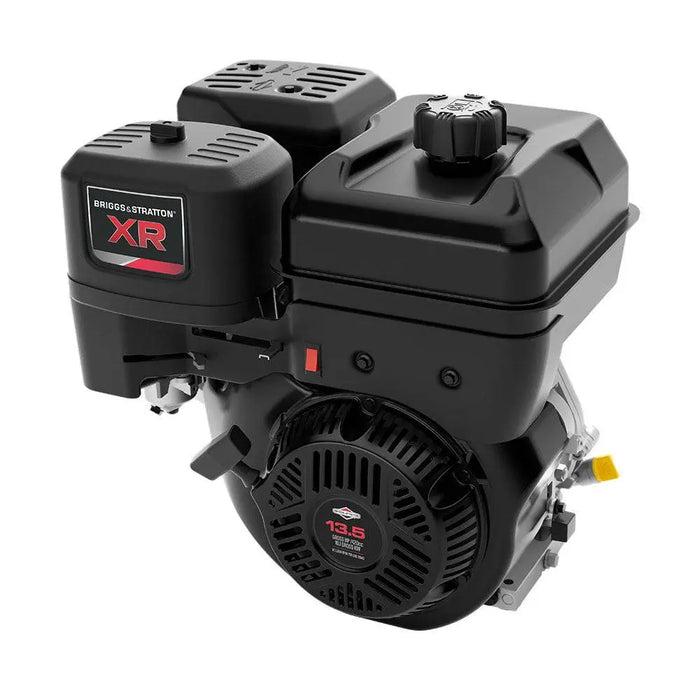
The end of the season is when the failures finally show
By late September most Canadian properties are done with the chipper, the pressure washer and the splitter, and the machines that struggled all summer are about to be parked for six months. A unit stored with a dead powerplant will not start in April either. A horizontal shaft engine is what most of that equipment is built around, and it cannot be swapped for whatever is on the shelf, because of which way the crankshaft points.
The crankcase is a bowl, and orientation moves the oil
Small engines are lubricated by throwing oil rather than pumping it. A dipper on the connecting rod or a slinger gear reaches into the puddle at the bottom of the crankcase and flings it over bearings and cylinder wall on every revolution.
That arrangement only works in the orientation it was designed for. Turn the bowl ninety degrees and the puddle moves away from the part meant to reach it. A vertical shaft unit laid on its side is not merely inconvenient; it runs its bearings on whatever film is left.
What a horizontal shaft engine ends up driving
A vertical crankshaft points down and bolts a cutting blade directly to its end, with no belt or coupling in between. That is why mowers are built that way and why almost nothing else is, since little other equipment wants its input spinning on a downward axis.
Pointing the shaft sideways puts a pulley, coupling or gearbox on the end instead. That is what a chipper disc, a pump impeller, a splitter pump and a go-kart axle all need, which is why this format is the general-purpose one.
Grouping engines by how the oil gets where it is needed
Catalogs sort by displacement and horsepower, which says nothing about how long a unit survives on a slope or under shock loads. Sorting by the lubrication method explains which engines tolerate sustained angles and which quietly wear their bearings.
A v twin horizontal shaft engine usually sits in the third group, because two cylinders and higher output make splash alone marginal. Single-cylinder units generally do not, which is one reason they are cheaper to build and simpler to service.
Torque at working speed matters more than peak output
A chipper or a splitter does not ask for steady power; it asks for a surge each time material engages, then almost nothing. What carries it through is torque near working speed, plus a governor that opens the throttle before the engine has slowed noticeably.
Peak horsepower is quoted at a speed the equipment rarely holds. A 20 hp horizontal shaft engine and a smaller unit with the same headline figure behave very differently in heavy material if one makes its torque higher up the range.
Choosing a replacement engine is a dimensional problem first
Choosing a replacement engine starts with shaft diameter, shaft length, keyway size and the bolt pattern on the mounting face, because one that will not couple correctly is wrong whatever its output. A horizontal shaft engine that fits mechanically may still need its throttle cable rerouted.
Work out the shaft dimensions and the shock loads the machine imposes before comparing power, since those answers eliminate most of the catalog immediately. The equipment guidance from TMG Industrial makes the same point about matching an engine to the driven machine rather than to a horsepower target.