

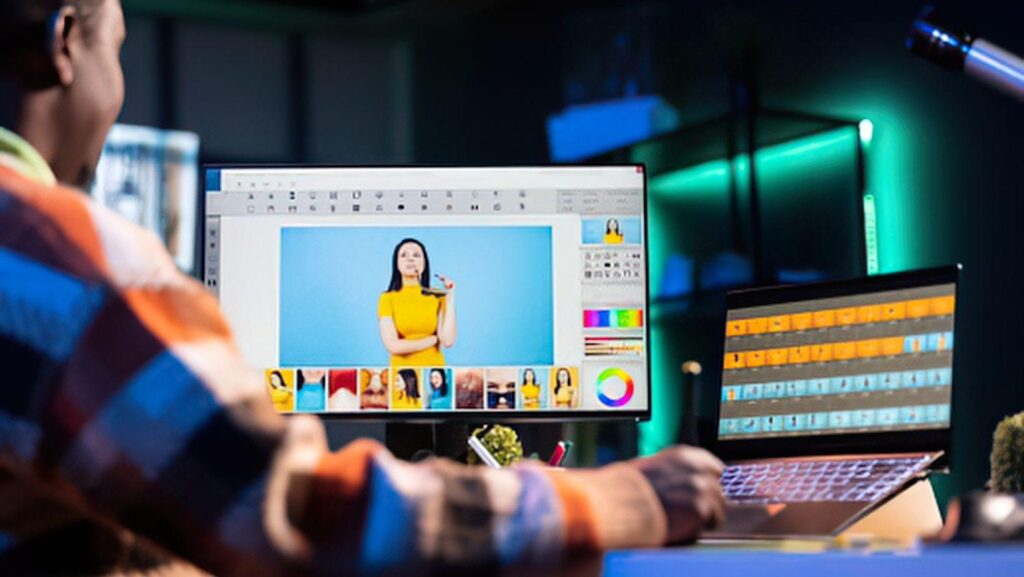
Creating digital images used to require a combination of technical knowledge, editing software, and plenty of patience. A simple task such as removing an unwanted object, changing a background, or adjusting the composition could involve several editing steps. Today, artificial intelligence is changing that process.
Modern AI image editors allow users to describe many visual changes in ordinary language rather than making every adjustment manually. Instead of searching through menus and learning complex tools, a creator might simply explain what should be changed and let an AI system handle much of the work.
This shift is influencing how marketers, designers, social media creators, photographers, and everyday users approach visual content. AI does not eliminate the need for creative judgment, but it can make experimentation considerably faster.
What Makes AI Image Editors Different?
Traditional image editing generally works through explicit instructions. A user selects an area, applies a filter, adjusts a layer, or changes individual settings. The final result depends heavily on the person's familiarity with the software.
AI-powered editors take a different approach. They can interpret an image alongside a written instruction and attempt to determine what the user means.
For example, a person could provide an existing photograph and request that the background look like a modern office. The system may identify the subject, preserve important details, and generate a new background that fits the overall composition.
The technology behind this process combines computer vision, generative models, image understanding, and natural-language processing. Instead of treating an image simply as a collection of pixels, modern systems attempt to understand objects, relationships, colors, lighting, and other visual characteristics.
That makes editing more conversational.
From Manual Adjustments to Prompt-Based Editing
One of the most noticeable changes is the growing role of natural-language prompts.
A conventional editor might require several separate operations to replace an object. An AI editor can potentially perform the same type of change from a short instruction such as, "Replace the coffee cup with a glass of orange juice while keeping the table and lighting unchanged."
The quality of the result depends on the model and the complexity of the request, but the underlying workflow is significantly different.
This is particularly useful when creators are experimenting with ideas. Instead of spending several minutes making one version and then rebuilding it to try another concept, they can generate multiple possibilities and decide which direction works best.
The result is not necessarily less creative. In many cases, it gives creators more room to concentrate on the creative decision itself rather than the mechanics of editing.
Common Uses for AI Image Editing
AI image editors are becoming useful across a wide range of digital-content workflows.
Background Replacement
Changing a background is one of the most common editing tasks. Product photographers can place an item in a different environment, while social media creators can experiment with different settings without arranging a new photoshoot.
AI can also help generate backgrounds that match the perspective and visual style of the original image.
Object Removal and Replacement
Unwanted objects can distract from an otherwise useful photograph. AI-based editing can identify those elements and reconstruct the surrounding area.
Creators can also use generative editing to replace objects with something different. This opens up possibilities for conceptual images, advertising mockups, and visual experimentation.
Image Expansion
Sometimes an image has the wrong dimensions for a particular platform. Rather than cropping away important content, generative tools can extend the image beyond its original boundaries.
For example, a landscape photograph could potentially be expanded to create additional space around the subject. This can be useful when adapting existing material for different layouts.
Creative Variations
AI editing also makes it easier to explore variations of an existing concept. A creator might experiment with different lighting conditions, color schemes, environments, clothing, or visual styles while keeping the basic composition intact.
This is valuable during the early stages of a project, when testing ideas is often more important than producing a final image immediately.
Why Context Matters
Not every AI image editor produces the same results. One important difference between systems is how well they understand context.
Imagine asking an editor to change the color of a person's jacket while keeping everything else unchanged. A useful system needs to identify the jacket accurately, understand its boundaries, and preserve the person's face, body, background, and lighting.
This becomes more challenging when instructions involve multiple objects or relationships.
For example:
"Move the chair closer to the table while keeping the person, room layout, and lighting consistent."
That is more complicated than applying a simple color adjustment. The system has to interpret the relationship between objects and generate a plausible result.
Newer AI image technologies are increasingly designed around this kind of contextual understanding. Tools and models associated with the Nano Banana 2.5 image editor category, for example, reflect the broader movement toward image editing that combines visual understanding with natural-language instructions rather than relying exclusively on conventional editing controls.
How AI Image Editing Helps Content Creators
For people who regularly publish digital content, speed can make a significant difference.
A social media manager may need several variations of an image for different platforms. A small business might need product visuals in several environments. A blogger may need an illustration that fits a particular article.
Traditional workflows can make these tasks time-consuming, particularly when the creator does not have advanced design skills.
AI tools can reduce some of that friction.
This does not mean every generated image is automatically ready for publication. Human review remains important. AI-generated edits can introduce incorrect details, strange textures, inconsistent shadows, or other visual problems. However, the ability to quickly produce a starting point can still save considerable time.
AI Editing and Marketing Workflows
Marketing teams are another major area where AI image editing can have an impact.
Campaigns often require multiple creative variations. Different audiences may respond to different imagery, and companies may need assets in several aspect ratios and formats.
Instead of creating every variation completely from scratch, a team can use AI-assisted editing to explore alternatives more efficiently.
For example, the same product photograph could be adapted for a website banner, social media post, promotional graphic, or mobile advertisement. The underlying product can remain consistent while the surrounding visual treatment changes.
This can shorten the distance between an initial idea and a testable creative asset.
Accessibility for Non-Designers
Another important change is accessibility.
Professional editing applications can be powerful, but their interfaces often require users to understand concepts such as layers, masks, selections, blending modes, and color adjustments.
AI interfaces can reduce some of that learning curve by allowing people to describe what they want.
Someone who has never mastered advanced photo-editing software may still understand an instruction such as, "Make the sky look like late afternoon and add warmer sunlight."
The technology therefore expands access to image manipulation. However, accessibility should not be confused with perfect automation. Users still need to understand what makes an image visually convincing and recognize when an AI-generated change does not look right.
The Limitations of AI Image Editors
Despite their rapid development, AI image editors have limitations.
Complex images can still produce inconsistent results. Fine details such as hands, text, jewelry, reflections, and intricate patterns may require additional correction. An AI system can also misunderstand an ambiguous prompt.
There are broader concerns as well.
Creators need to consider copyright, consent, authenticity, and disclosure depending on how generated or altered images are being used. In professional settings, an AI-generated image may need human review before publication, especially when accuracy matters.
There is also a difference between creating an attractive image and creating an accurate one. AI is designed to generate plausible visual results, but plausibility does not necessarily mean factual correctness.
What This Means for the Future of Digital Content
AI image editing is moving toward a workflow where creation and editing become less separate.
Instead of taking a photograph first and performing a long series of manual adjustments afterward, creators may increasingly describe a visual goal and use AI to explore possible versions.
That could make the creative process more iterative. A creator might generate an initial concept, adjust it through several prompts, compare variations, and then use traditional editing tools for final refinement.
In that workflow, AI becomes less of a replacement for creative software and more of an additional layer within it.
The most useful systems will likely be those that combine strong image understanding with precise editing controls. Users need both flexibility and predictability: the ability to make substantial changes when necessary while preserving important details when they ask the system not to alter them.
A Changing Creative Workflow
The biggest impact of AI image editors may not be a single feature. It is the change in how people approach visual creation.
Ideas that once required considerable technical effort can now be explored more quickly. Beginners can experiment without mastering every editing function, while experienced designers can use AI to speed up repetitive tasks and generate starting points.
There will still be situations where conventional editing remains essential. Professional designers often need exact control over typography, color, layout, and individual elements. AI-generated results may also require careful correction.
But the boundary between generating an image and editing one is becoming increasingly blurred.
For digital creators, that means the future of image editing may involve a combination of human judgment, traditional tools, and AI assistance. Rather than replacing creativity, these systems are changing how quickly an idea can move from imagination to something visible and testable.
As AI image technology continues to develop, the most important skill may not be knowing every editing command. It may be knowing what you want to communicate, describing that goal clearly, and recognizing when the resulting image successfully communicates it.